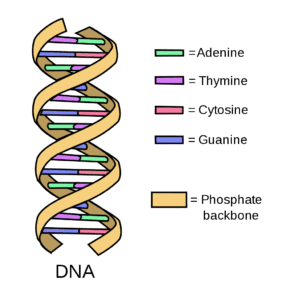
 (1)
(1)Another newly developed vaccine type are RNA vaccines. Similar to how DNA vaccines would work the RNA which is coded for an antigen is injected into the lymph nodes, where the RNA be used to build an antigen that can be presented to the immune system to create antibodies and memory. The injection of RNA will not effect the cell's natural DNA or disrupt the cell's natural processes. The only issue with using RNA to vaccinate is that it can degrade very quickly due to temperature changes.(3)
 (4)
(4)
1Building Blocks of the Genetic Code. (2019, November 21). Retrieved May
1, 2020, from https://www.ashg.org/discover-genetics/building-blocks/
2DNA vaccines. (2011, October 12). Retrieved May 1, 2020, from https://www.who.int/biologicals/areas/vaccines/dna/en/
3Kalema, & Bishop, H. A. (2015, July 10). RNA vaccines: a novel
technology to prevent and treat disease. Retrieved May 1, 2020, from
http://sitn.hms.harvard.edu/flash/2015/rna-vaccines-a-novel-technology-to-prevent-and-treat-disease/
4MacKenzie, R. J. (2018, January 25). DNA vs. RNA – 5 Key Differences and
Comparison. Retrieved May 1, 2020, from
https://www.technologynetworks.com/genomics/lists/what-are-the-key-differences-between-dna-and-rna-296719
